Thursday, July 27

Are you hearing a call to ministry?

I received this today from the Commission on Ministry. Developing new clergy leaders is incredibly important. Please consider whether you or someone you know might be called to lay or ordained ministry.

Once again, the Commission on Ministry is happy to come to you with our Discernment Program for the coming year. This is a wonderful opportunity for adult members of the Body of Christ in Rhode Island to reflect and grow in their faith. It is also the first step in the process leading to ordination for the diaconate and the priesthood.

The program is very similar to the one offered last year. As a result of feedback we received from last year’s participants, we are including a presentation on lay ministry, in addition to the presentations on the diaconate and priesthood.

The first session is an Introductory Dinner that is being held at the Hallworth House on September 14, 2006 at 6 PM. All clergy have information on the program, so please speak with your parish clergy if you are interested.

Wednesday, July 26

When two parishes become one

We've had a couple of parish mergers in Rhode Island in the last year or so. One was Church of the Advent, Pawtucket joining with Good Shepherd, Pawtucket. More recently, on the Day of Pentecost, two Providence parishes merged. Church of the Messiah, Olneyville joined with Grace Church.

If you are curious what it's like, liturgically, to deconsecrate a building (to return it to secular use) and to join two parishes, the current issue of the Grace Church newsletter (PDF) has a nice write-up of the day. There's also a profile of a parishioner, Lucia Bomster, worth reading. She was senior warden at Messiah, and she write about her experience coming to Grace Church. Rather than seeing this moment of uncertainty and transition as a time of fear, Bomster writes about the possibilities it brings:

The warm welcome and inclusion that Grace has off ered to both my Messiah family and my smaller personal family feels so much like that acceptance that Messiah blessed me with 16 years ago. Even though merging with another church was not one of the paths any of us wished for or dreamed to be God's plan for us, I have come to see this part of our journey in a very different light. I see this merger as a blessing too. I look forward to the two church families blending our different gifts and strengths together and becoming a stronger and more effective "tool" of God. It is beginning already with the creation of the Blending Team and the joining of our two Christian Ed teams!! I can’t wait to see where this part of the journey takes us!

This kind of hope is something we need more of. Speaking of things we need more of, I commend the Grace Church newsletter, which is posted on their website. It's nice looking and filled with fresh content. If your parish newsletter looks stale and takes only a few seconds to read, it's time to update. Grace Church's newsletter might make a fine model.

Sunday, July 23

CBS: The Episcopal Church's New Pilot

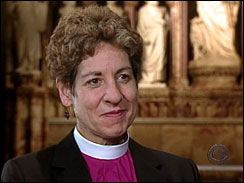
There was a brief interview with Presiding Bishop-elect Katharine Jefferts Schori on the CBS Evening News today. You can read the interview (well, it's a transcript turned into an article) or watch the video here.

Here's a sample:

At the end of her term in nine years, how will she measure her success? "Well, I would hope to see a church that is less focused on internal division and far more focused on the world around us, transforming the communities in which we live," Jefferts Schori said.

Saturday, July 22

Thoughtful writing from two perspectives

I've run across a couple of decent essays in the last few days. They don't have much to do with each other, except that they both articulate their positions well. I commend both.

First, from two senior bishops in the Church of England, is a response to Cardinal Kasper, who told the English House of Bishops in a recent address that they should not proceed to ordain women as bishops, lest they damage ecumenical relations. This charge is summarily dealt with (i.e. the pope declared in 1896 that Anglican holy orders are "absolutely null and utterly void" so how much more damaged can we be?), and then they move on to a careful exposition of why women bishops are OK, even with 2000 years of tradition. Here's a choice excerpt:

Faced with Rome's charge that Anglican innovations might make a projected unity more difficult, even those in the Vatican most concerned with patrolling the boundaries must recognise that to many Anglicans it seems that this charge could be levelled the other way round. The dogmas relating to the papacy (1870) and to Mary (1950) remain real obstacles for many who find it difficult to recognise them as developments in any sense from scripture and the tenets of the early church, and the recent work of ARCIC has not managed to find a pathway to help the churches travel together in these areas. The 'filioque' clause in the Creed is to this day regarded by Eastern Orthodox Christians as an unwarranted Roman addition to the creed of the universal church. Anglicans will naturally ask by what criteria Rome claims the right to introduce potentially divisive innovations in some areas, while advising Anglicans against developing the practice, rather than altering the doctrine of the church, in others. In what sense would ordaining women to the episcopate alter the doctrine of the church?

In a completely different vein, this brief essay by Bishop Iker of Forth Worth (and possible superhero?) summarizes the reasons why he has asked for alternative primatial oversight. If you are of a liberal persuasion and you haven't heard the conservative viewpoint on these issues, Iker's essay is a good, brief insight into at least one conservative position.

We realize that the Archbishop of Canterbury has a limited sphere in which to maneuver. We do not seek the impossible. We ask for some pastoral strategy whereby we might come under his primatial oversight and pastoral care (or that of another appointed by him) until such time as the primates’ meeting and the other instruments of unity of the Communion are enabled to consider our predicament and offer us help and protection. We cannot believe that because we are in a minority in this church we can be required to receive and endorse, in the person of the Presiding Bishop, a ministry which we have heretofore consistently, courteously and legitimately refused, and which is neither legitimate nor welcome in the greater part of the Communion.

Friday, July 21

Sunday services might be the answer, or not

I saw an interesting news bit from the Church of England today. It's a new version of an old question: "How do we make church relevant in a secular world?" In this country in the 1950s, it might have worked to expect people to come to church on "our" terms. Churches who live that way now do so at their own peril (witness the number of dying parishes). It's time to think in new ways.

A senior Church of England researcher has called on parishes to expand the scope of their vision, urging churches to think beyond their own walls and beyond the hours of Sunday in their attempts to engage communities with the message of the Gospel.

"Are we prepared to be flexible and responsive in our approach to church buildings and church services as we seek ways to respond to the widening gap between the inherited faith of the nation and its current practice, understanding and nurture of that faith?" asks the Rev'd Lynda Barley, Head of Research and Statistics for the Archbishops’ Council, in a booklet published today.

You can order a copy of the research from the C of E. It's called "Churchgoing today." While it's aimed at an English audience, I'll bet it has much to say to us on this side of the ocean. Dead tree version only -- no PDF, alas.

Thursday, July 20

CBS Evening News plans July 23 profile of PB-elect

[ENS] A CBS Evening News profile of Presiding Bishop-elect Katharine Jefferts Schori is scheduled to air nationwide during the 6 p.m. EST newscast on Sunday, July 23, after last week's planned airing was pre-empted by breaking news.

The profile centers around a July 13 interview conducted by CBS News anchor Russ Mitchell with Jefferts Schori on the campus of the General Theological Seminary in New York City.

Should the profile be rescheduled due to time constraints, the segment will air at a later time, said producer Chris Hulme.

Clergy and lay leaders may wish to make this announcement in congregations during July 23 Sunday services.

Welfare ended, poverty remains, Griswold, mainline leaders tell Congress

Presiding Bishop Frank Griswold, along with other denominational leaders, has written a letter to Congress urging them to deal with increasing poverty, rather than celebrating the end of welfare. In the letter, the denominational leaders said this:

Our five denominations, steeped in the biblical imperative to care for the "least of these," represent close to 20 million members in the United States. We understand that many in Congress may be inclined to celebrate a political anniversary: the tenth anniversary of the signing of the Personal Responsibility and Work Opportunity Act of 1996 (PRWORA) and the "successes" of the law that as President Clinton said, "ended welfare as we know it." This is a celebration in which we cannot join. Welfare may have ended as we know it, but poverty in our nation has not.

PRWORA is not a success when many of our brothers and sisters lack adequate access to affordable child care, education and training, health care, affordable housing, quality nutrition and other basic human needs. Despite caseload reductions in the Temporary Assistance for Needy Families program (TANF), child poverty has risen for the last 4 years. According to recent US Census figures, the number of Americans living below the poverty line has increased every year since 2000 from 11.3% in 2000 to 12.7% in 2004. This now represents 37 million Americans, including 13 million children.

For some reason, the full text of the letter and news release are not on the ENS website, although I received a copy from them by email earlier this morning. When it appears online, I'll post a link to the news release, which contains the full text of the letter.

UPDATE: The article has magically appeared on the ENS website now. Enjoy.

Tuesday, July 18

You can make a difference

I received this in an email today from the Diocese of Mississippi. Please give it some thought. As readers here will know, people from our diocese have already had some great experiences in New Orleans doing similar work. Doing this work will change your life, make a difference for people on the Gulf Coast, and it will positively impact your whole faith community.

Camp Coast Care, a Katrina recovery ministry of Lutheran Episcopal Services in Mississippi, is in continued need for volunteers and work crews throughout the coming months. Our numbers for scheduled crews begin to taper off in early August: we need skilled and unskilled laborers to help continue to rebuilding efforts for so many who were impacted by last summer'’s storm. There is always something meaningful for anyone and everyone who comes to help.

To learn more about the work that Camp Coast Care is doing, please visit their website at www.campcoastcare.com and also the LESM website at www.lesm.org. Specific information on volunteering is available in the menu at the left side of the CCC website. The minimum age for volunteers housed at CCC is 16. For youth groups or volunteers under the age of 16 please contact Mission-on-the-Bay Camp Coordination Team: John Dreyfus 601-917-0794; Joelle Wright 619-865-8100; Butch Jones 228-860-8777; John Berault e-mail: missiononthebay@yahoo.com.

Evangelism starts best with clear soup

I ran across a thoughtful article from another blog. It begins like this:

A hiker emerges from the wilderness. He's rail-thin, having survived for weeks on what he could forage. Well-meaning greeters urge him to share in the rich, delicious meal they themselves are eating: sixteen-ounce steaks with sauteed mushrooms and onions; baked potatoes with butter and sour cream; and chocolate sundaes with whipped cream. Accustomed to leaner fare, however, the hiker manages to get down only a bite or two before his stomach rebels, and he has to turn away from the table. He would have been better served if his greeters had recognized his condition and started him out on just a little clear soup.

Unfortunately, some Christian evangelists are like the well-meaning greeters. They offer non-believers a rich meal of theological doctrines — delicious to those accustomed to them, but hard to digest for those who aren't, especially those brought up in the West's culture of rationality. Some evangelists dismissively label anything less than the full meal as cafeteria Christianity; they tell their listeners that true faith is an all-or-nothing proposition. Sadly, a lot of thoughtful non-believers respond to this challenge by choosing the nothing option.

I encourage you to read the full post. Many readers of this blog will not agree with his talking points, as they're quite liberal. Nevertheless, I think his point is well taken. Wherever we are on the theological spectrum, we do well to begin near those with whom we are conversing. I think Paul had something to say about that.

Monday, July 17

Leaning left, and also leaning right

It would be easy to think that all parishes are easily defined in their theological and political positions, at least based on most news reports. Here's a story from today's New York Times about a parish on the Upper West Side of Manhattan. It's quite liberal in its politics, but conservative in theology. This is another example of how a mission-focused church might have a chance to stay together.

The parish, on the Upper West Side of Manhattan, clings to a staunchly conservative theology, even though it is in an overwhelmingly liberal diocese of the Episcopal Church of the United States. Many in the congregation of about 300 young professionals, artists and even homeless people are proudly liberal in their politics. But they do not seem to carry that liberalism into their plain sanctuary, bathed in warm sunlight on Sunday mornings.

They've got things in perspective, I think. Here's a bit from the rector:

Mr. Sojwal said he believed many conservative Christians had elevated homosexual acts above all other sins. In his congregation, he said, sins like greed and materialism are of more pressing concern. “Jesus had nothing to say about homosexuality,” he said. “He has a lot to say about money.”

Nevertheless, he reads the Bible conservatively on homosexuality, saying he cannot find any way around the admonitions about it in the Old and New Testaments. Most in All Angels side with Mr. Sojwal in his reading of the Bible on the issue, but that does not mean they are at peace with it.

It looks like the principal concern of this parish with respect to ECUSA is not Gene Robinson, but rather a general leftward drift on scriptural authority. They want to talk about salvation, not sexuality. It's a conversation worth having, I think.